
Some links in this guide are affiliate links. If you buy through one, The Big Day Bulletin may earn a small commission at no extra cost to you. It never changes what we recommend or what we say about it. Full disclosure here.
There are two ways to get a wedding guest outfit wrong. You can be underdressed, which is uncomfortable for an hour. Or you can be uncomfortable, which is a problem for fourteen.
Most guest outfit guides only solve the first one. This one covers both, because a British wedding is a long day involving grass, weather, a receiving line, three hours of standing and at least one unheated stone building. Your outfit has to survive all of it.
The short version
- White is out. So is anything that photographs as white. Cream and ivory included.
- Check the invitation for a dress code before anything else. If there isn’t one, dress one notch smarter than you think.
- Block heels for anything outdoors. Stilettos and lawns do not get along.
- Budget roughly £120 to £250 for a full outfit you’ll wear again, less if you rent or reuse.
- Bring a layer. Every British wedding gets cold at about half past eight.
Decoding the dress code
Dress codes on UK invitations are rarely as strict as they sound, but they do mean something. Here’s the translation.
| What it says | What it means | Safe choice |
|---|---|---|
| Black tie | Genuinely formal. Floor length or a very dressy midi. | Long gown or dressy midi, proper jewellery |
| Formal / lounge suit | Smart but not black tie. The most common UK code. | Midi dress or tailored jumpsuit |
| Semi-formal | Smart daywear. No gowns. | Midi dress, smart separates |
| Cocktail | Knee to midi length, a bit of shine. | Cocktail midi, heels, statement earrings |
| Garden party | Florals, lighter fabrics, block heels. | Midi in a print, flat or low heel |
| No code given | Formal, in practice. | Midi dress or tailored separates |
If the invitation says nothing at all, look at the venue instead. A country house hotel and a converted barn ask for different things, and the venue name in the invitation tells you more than any code would.
The Guest Outfit Planner
If you’re going to more than one wedding this year, this is the thing that stops you buying a fourth dress you’ll wear once. A printable planner for building outfits you’ll actually re-wear.
- Dress code decoder and a venue-type checklist
- Outfit builder sheets so you can log what you wore where, and avoid repeating in front of the same crowd
- A packing list for weddings that involve an overnight stay
- Budget tracker across multiple weddings in one season
Get the planner
Instant download
The three actual rules
Most wedding guest etiquette is invented. These three aren’t.
Don’t wear white. This includes cream, ivory, oyster, champagne and anything that reads as pale in a photograph. A white floral print on a strong background is fine. A pale dress with a small pattern is not, because in the group shot it will look like a white dress.
Don’t upstage. That means length, drama and sparkle rather than colour. Red is fine. A floor-length beaded gown at a low-key registry office wedding is not, and the problem there is the beading, not the colour.
Check whether the couple has asked for something specific. Some request a colour palette, some ask guests to avoid black, some ask everyone to wear it. Whatever they’ve asked for, do it. It’s their day and it takes you five minutes.
On wearing black
The old rule that black is unlucky at a wedding has effectively gone in the UK, and a black midi is now one of the most common guest outfits at an evening reception. The exception is a daytime church wedding with an older congregation, where it can still read as funereal. If in doubt, break it up with colour at the shoes or the jewellery.
Dresses, and what to actually look for
Midi is the length that works for the widest range of UK weddings. It’s smart enough for formal, relaxed enough for a barn, and long enough that you’re not managing a hemline every time you sit down.
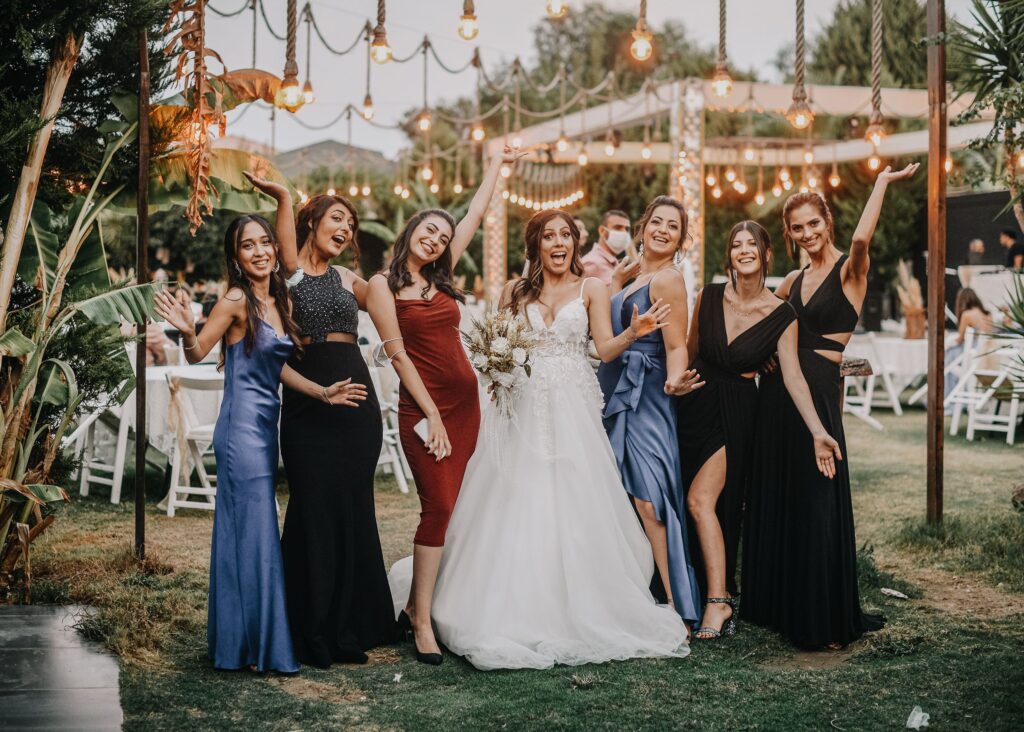
A midi dress in a strong colour or print
Buy for the fabric, not the hanger appeal. Anything with a bit of weight to it will hang properly all day and won’t crease into a map of the car journey. Check it has a lining, because unlined occasionwear goes transparent in sunlight and you’ll only discover this in the photographs.
A word on sizing. Occasionwear is cut smaller than high street casualwear as a rule, and order two sizes if you’re buying online with a wedding close. Returning one dress is easier than finding a tailor in the week of.
If you’d rather not wear a dress
Perfectly normal, and increasingly common at UK weddings. Two routes, both entirely appropriate for any dress code short of black tie.
A tailored jumpsuit or co-ord set
Reads as formal, moves like separates, and solves the wind problem at outdoor ceremonies entirely. The one thing to check before you buy: how you’ll manage in the loo, particularly with a one-piece and a fitted bodice. It sounds trivial at ten in the morning and does not feel trivial at six in the evening.
A well-cut suit
The highest cost per outfit and by far the lowest cost per wear, because it goes on to do work, funerals and every other wedding you’re invited to. Colour does the heavy lifting here. A suit in sage, terracotta or dusty blue reads as occasionwear in a way that navy and grey never will.
Shoes, and the grass problem
This is where most guest outfits fail, and it fails at about four in the afternoon.
If any part of the day is outdoors, and at a UK wedding it usually is, stilettos will sink. Drinks receptions happen on lawns. Photographs happen on lawns. You will spend an hour on grass whether the plan says so or not.
A block heel, 5cm to 7cm
High enough to look considered, stable enough to survive a lawn and a dance floor. Wear them in properly around the house for a few evenings first. New shoes and a twelve-hour day is how people end up barefoot by the first dance, which is fine but not ideal in the photographs.
The emergency kit
Anti-blister balm applied before you leave, not after it hurts. Heel grips for shoes that are half a size generous. A spare pair of tights, because one snag ends them. Total cost is less than a round of drinks and it saves the back half of your day.
Layers, bags and jewellery
Three details that decide whether the outfit works, in rough order of how often they get forgotten.
A proper layer
Not a cardigan you also wear to the shops. A tailored jacket, a good wrap or a structured coat that belongs with the outfit rather than apologising for being there. Churches are cold, marquees are colder after dark, and a borrowed suit jacket over your shoulders ruins every photograph taken after eight o’clock.
A bag that actually holds things
A tiny clutch looks right and holds a phone. You need a phone, a lipstick, plasters, tissues, painkillers and an order of service you’ll be handed and can’t put down. Go one size up from the one you first picked.
One piece of jewellery that isn’t costume
The quickest way to lift a mid-price dress is a single good piece rather than three cheap ones. A fine chain with something meaningful on it photographs beautifully in the close-ups and carries on into everyday wear afterwards, which is not true of statement costume pieces.
Dressing for the venue type
- Country house or hotel: the most formal of the common UK options. Midi or long, heels are fine indoors, bring a wrap.
- Barn or farm: uneven ground, often a walk between ceremony and reception. Block heels or smart flats, and skip anything floor length.
- Church then reception: shoulders covered for the ceremony at more traditional churches. A jacket you can remove afterwards handles it.
- Registry office: smart but not formal. A good midi or a suit is plenty, and a full-length gown will feel wrong.
- Marquee: the coldest option after dark by some distance. Layers are not optional.
- Abroad: lighter fabrics, and check whether the ceremony venue has a covered-shoulders rule. Many European churches do.
Going to a winter wedding? The rules shift enough that we’ve covered it separately in what to wear to a winter wedding.
The Venue Question Checklist
Forty-one questions to ask before you book anything, including the seven most couples only think of afterwards. Free, and it lands in your inbox in a minute.
Common questions
Can I wear the same outfit to two weddings?
Yes, unless the guest list overlaps heavily. Change the shoes, the jacket and the jewellery and most people won’t clock it. If the same twenty friends are at both, it’s more noticeable, and that’s exactly the problem the outfit planner solves.
Is it acceptable to wear black to a wedding?
In the UK now, generally yes, particularly for an evening reception. Break it up with colour somewhere and avoid it for a traditional daytime church service if the congregation skews older.
How much should I spend on a wedding guest outfit?
Around £120 to £250 buys a complete outfit you’ll wear again. If you’re going to several weddings in one season, renting one or two of them usually works out cheaper than buying, and takes the pressure off repeating.
What if I’m pregnant?
Prioritise fabric and length over cut. A stretch jersey or crepe midi will see you through several sizes, and a good wrap dress adjusts as you do. Flats or a very low block heel, and expect to be warmer than everyone else in the room.
Do I have to follow the couple’s colour palette?
If they’ve asked, yes. It’s usually because they want the photographs to hang together, and being the one person who ignored it is a very visible way to be remembered.
The test that matters
Put the whole outfit on, shoes included, and spend an hour in it at home. Sit down. Stand up. Reach for something on a high shelf. Walk up and down the stairs a few times.
If anything pinches, rides up or needs adjusting more than once, it will do the same thing at the wedding, except you’ll be doing it in front of a photographer.
The Big Day Bulletin exists to make this process feel less overwhelming and more enjoyable. Whether you’re at the very beginning like right now, or knee deep in seating plans and supplier emails, we’ve got guides, ideas, and honest advice for every stage. Browse the blog, bookmark what’s useful, and come back whenever you need it.
Found this helpful? Save it to Pinterest so you can find it again when you need it – or share it with a newly engaged friend who could do with a calm, sensible starting point.