Some links in this guide are affiliate links. If you buy through one, The Big Day Bulletin may earn a small commission at no extra cost to you. It never changes what we recommend or what we say about it. Full disclosure here.
DIY wedding decor is sold to you as the easy saving. Sack off the stylist, buy a crate of jars, spend a few evenings with a glue gun, keep a couple of grand. Sometimes it goes exactly like that. Often it doesn’t, and it goes wrong at eleven at night in the last fortnight, when someone’s still cutting ribbon and nobody has packed the car.
So the question isn’t whether to DIY. It’s which jobs hand back real money for sensible effort, and which cost more in time and stress than a supplier would have charged.
The short version
- Realistic saving: £600 to £1,500 on an 80 to 100 guest wedding. Not the £3,000 you’ve seen claimed.
- Biggest time trap: large floral installations. Arches and hanging displays eat whole weekends and still look homemade.
- Golden rule: nothing that must be made or arranged on the wedding morning should be your job.
- Buy in bulk, buy early, buy once. Most overspend is panic reordering in the final month.
- Check the venue’s rules first. Flames, confetti and wall fixings catch people out after the money’s gone.
- Have an exit plan. Decide where it’s stored and who’s selling it afterwards.
What DIY wedding decor actually saves
Let’s put a number on it, because the internet won’t.
A full styling package covering ceremony, tables, signage and setup runs from about £1,200 to £3,000. Do it yourself and you’ll still spend £400 to £900 on supplies for around 100 guests. So the honest saving sits between £600 and £1,500. Worth having. Not the figure people imagine while pricing up jars at midnight.
The cost nobody counts is your hours, and thirty to fifty is normal. If you like making things, that’s a run of pleasant Sundays. If you don’t, it’s a second job at roughly £20 an hour. Our UK wedding budget breakdown puts the decor line in context.
What’s worth DIY-ing, and what to hire
The pattern is simple once you see it. DIY works for small, repeatable, flat things you can make months ahead and stack in a box. It fails for anything big, perishable, needing a ladder, or happening while you’re having your hair done.
| Job | Verdict | Why |
|---|---|---|
| Table numbers and place cards | Worth DIY-ing | One evening’s work, stored in an envelope. |
| Welcome sign and seating plan | Worth DIY-ing | High visual payoff for £40 of materials. |
| Order of service | Worth DIY-ing | Design once, print locally, fold with a glass of wine. |
| Candle styling and votives | Worth DIY-ing | Bulk buying is where the saving lives. |
| Favours | Worth it, with limits | Fine at one component per guest. Miserable at three. |
| Table linen | Hire | Buying and laundering twelve cloths costs more, and you’ll iron for days. |
| Large floral installations | Hire | Scale, mechanics and skill. The job that breaks people. |
| Anything structural | Hire | Draping and rigging are insurance questions, not crafts. |
| Anything needed on the morning | Hire or delegate | You won’t be free. Nor will anyone who loves you. |
If you take one thing from this post, take the last row.
Hand the large florals to a professional
Big floral work is the one job that regularly costs more in DIY than it saves. Flowers have to be bought fresh, conditioned overnight, arranged the day before and installed on the morning, which is the exact window when you have no time at all. If the flowers are the thing you care most about, get a quote before you commit to doing them yourself. It’s often closer to the DIY cost than people expect, once you’ve added buckets, foam, conditioning, a cold room and a van.
Ask your venue before you buy a single thing
Three rules catch everyone out. Many UK venues, especially listed buildings, marquees and barns, ban naked flames or insist every candle sits inside glass. Most allow only dried or biodegradable confetti, and plenty allow none indoors. And almost none will let you fix anything to walls, beams or paintwork, which rules out the hanging installation you’ve pinned forty times. Get it in writing. Our wedding venue checklist has the questions to ask.
The ceremony
Guests sit here for twenty-five minutes, and for most of it they’re looking at you. Two focal points do the whole job: something where you’ll stand, and something marking the aisle entrance. Skip pew ends. They’re fiddly, they cost a fortune across fifteen rows, and half end up hidden behind hats.
Want an arch? Hire the frame and have a florist dress two corners rather than the full sweep. A third of the price, and it photographs almost identically, because nobody shoots an arch square-on.
Dried and preserved flowers
The best value in DIY wedding decor ideas right now. Bunny tails, pampas and preserved eucalyptus arrive months early, don’t wilt, and can be arranged in February for an August wedding. Buy 30% more than you need: stems snap in transit and colour lots vary between orders.
Faux greenery garland
Good faux greenery dresses a top table cheaply, and unlike fresh foliage you can resell it. The trap is shine: cheap plastic reads as fake across a room and photographs worse than it looks. Check one length in daylight before committing to six.
For where fresh flowers earn their cost, see our wedding flower edit.
The tables
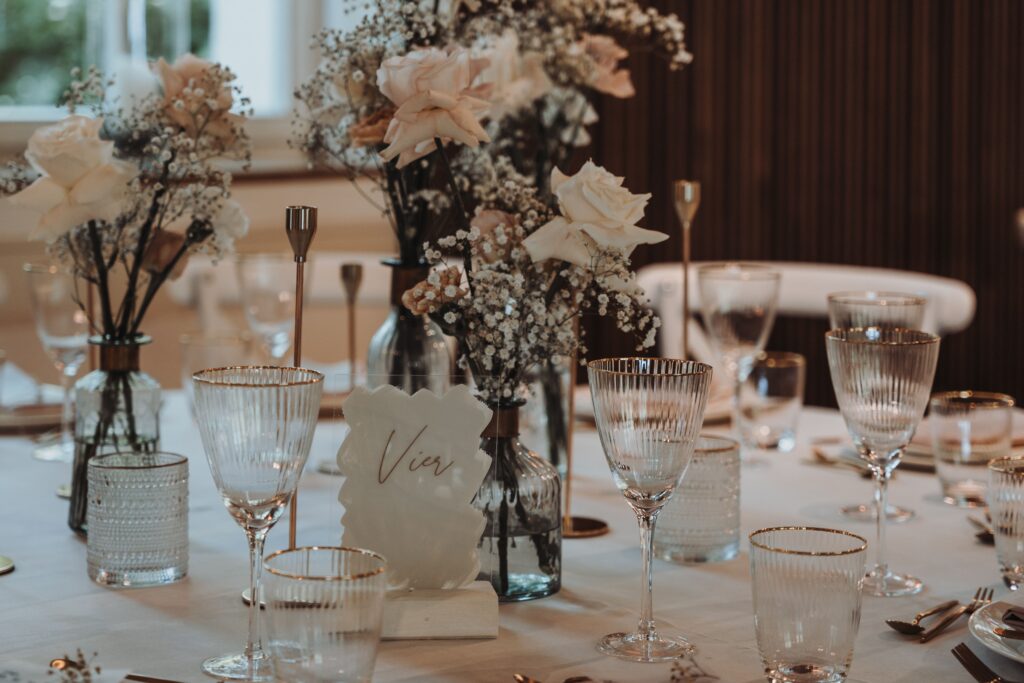
Here’s where DIY pays best, because tables are repetition. Cost up one table you love, then multiply. Ten identical good tables beat ten individually creative ones. Candles do the heavy lifting, and height variation stops a table looking flat, so mix tapers, pillars and low votives rather than buying one type in a job lot.
Taper and pillar candles, by the box
Buy in cases of 50 or 100 and the unit price falls off a cliff, which is the whole argument for DIY-ing your tables. Go unscented and dripless: scent fights with the food, and drips ruin hired linen you’ll be billed for. Check burn time, because four-hour tapers won’t reach the first dance.
Candle holders and votives
Plain glass votives at about a pound each, bought thirty at a time, beat a few expensive ceramic ones spread thin. If your venue insists on enclosed flames, hurricane glass solves it and looks deliberate rather than apologetic. Count five to eight per table, and buy spares.
Bud vases and glass bottles
Three bud vases with two stems each costs roughly £6 a table and reads as restraint rather than thrift. Buy multipacks in one shape and one glass tone. Mismatched vintage bottles work, but they need to be genuinely mismatched, not four styles from one website.
Hessian or washed linen runners
A runner covers a multitude of sins on a plain hired cloth, and washed linen in a soft neutral looks expensive. Hessian looks rustic, but it sheds fibres onto food and irritates some people’s skin. Order a sample metre before you buy twelve.
Lighting
Nothing changes a room more cheaply. A village hall under strip lights is a village hall; the same hall with the overheads off and five hundred warm bulbs above it is somewhere else.
Two rules. Warm white only, never cool white, which turns skin grey in photographs. And battery or plug-in only unless you’re paying an electrician, because trailing leads across a dancefloor is how you meet the venue manager.
Fairy lights and battery festoon
Buy more than feels reasonable, because most people underbuy by half and end up with a thin, sad line of bulbs along one wall. Get battery packs with timers so nobody’s under a table at seven o’clock. Test every set the week before: roughly one in ten arrives dead.
Signage and stationery
Signage is the highest-return DIY job going. A welcome sign, an order of service, a seating plan and table numbers might cost £40 in materials against £250 from a stationer, and they’re all made sitting down, weeks ahead.
Be honest about your handwriting, though. If it’s untidy, buy vinyl lettering for the blank, or have a print shop run the sign flat. Wobbly hand-lettering on clear acrylic is the biggest giveaway going.
Acrylic and wooden sign blanks
Blanks in acrylic, birch ply or slate cost a fraction of a finished sign and take any lettering you like. Frosted or smoked acrylic hides fingerprints and small mistakes far better than clear, which shows everything and needs a busy background to read at all. Order a spare of every size. You will ruin one.
Calligraphy and paint pens
Chalk pens for slate, oil-based paint pens for acrylic and wood, brush pens for card. Match the pen to the surface or it’ll bead, smudge and wipe off in your hand. Practise on scrap first: your fifth attempt will be twice as good as your first.
Keep one typeface across everything, because mixing fonts loses the polish you just paid for. Our guide to wedding stationery etiquette covers the wording for your order of service.
Favours
An unpopular opinion: most favours end up in a bin bag with the napkins, and nobody has ever complained about a wedding without them. If you’re wavering, put the money behind the bar.
If you do want them, hold yourself to one component per guest. The moment a favour becomes a jar plus a tag plus twine plus a printed card, you’ve signed up to four hundred assembly steps, and that’s the job still unfinished the night before. Edible beats keepsake. Buy the card box rather than making it: a wobbly homemade box holding envelopes of cash is a poor idea.
The Venue Question Checklist
Forty-one questions to ask before you book anything, including the seven most couples only think of afterwards. Free, and it lands in your inbox in a minute.
When to make it, and where to store it
Work backwards from six weeks out, because the last month belongs to seating plans, final numbers and dietary requirements. Buy supplies four to six months ahead while sales are on, make signage three months out, arrange dried flowers two months out, and leave packing for the final fortnight.
Storage turns spare rooms into warehouses, and two rules save you. No lofts and no garages: damp warps card and dulls dried stems, while heat bends candles into commas. And pack by destination, not by type. One labelled box per table, one for the ceremony, one for signage, each with a list taped to the lid, so whoever’s setting up carries a box to a table and unpacks it. Stackable crates beat cardboard.
The Colour Palette Mood Board
The single biggest reason DIY decor looks like DIY decor is that it was bought in six separate orders over four months, each one slightly off from the last. Fix the palette first and the rest follows.
- Build and lock your palette before you order anything
- Swatch sheets you can take to a shop or send to a supplier
- Keeps candles, linens, stationery and flowers reading as one decision
Get the mood board
Instant download
How to make DIY decor look expensive
Expensive-looking weddings aren’t the ones with the most stuff. They’re the ones with the fewest ideas, repeated confidently.
Pick two materials and one metal, then stick to it religiously. Glass and linen with brass, say, or ceramic and dried stems with black. Every extra material halves the effect of the ones already there. Concentrate the spend at eye level: the tables, the sign guests pass on the way in, the bar. Nobody looks at the corners of a room.
What gives DIY away, in rough order of how often it happens: visible battery packs and wires, printer paper that’s too thin (use 300gsm or heavier for anything guests pick up), mismatched fonts, glue residue on jars, shiny plastic greenery, and candles at wildly different burn levels because half were lit early. All fixable in advance, for nothing. If the look isn’t settled yet, start with how to choose a wedding theme: a coherent palette does more for a room than any single purchase.
What to do with it all afterwards
Decide this before you buy, because it changes what you buy. Neutral, undated items in popular colours resell well. Anything printed with your names and the date is landfill by Sunday.
Sell through the wedding resale groups on Facebook, or on eBay and Vinted for smaller lots, and expect to recover 30% to 50% of what you paid on glassware, lighting, sign blanks and unopened candles. Put someone else in charge of clear-down, and sell within a month. Leave it six and it’ll sit in a hallway until you give it away.
Common questions
Is DIY wedding decor genuinely cheaper?
Yes, but by less than you’d hope. Budget £400 to £900 on supplies for around 100 guests and expect to save £600 to £1,500 against a full styling package. The saving comes almost entirely from bulk buying, so it shrinks if you shop in small panicked batches.
How far ahead should I make everything?
Finish by six weeks out. Buy supplies four to six months ahead and make signage three months out. Anything still on the list in the final week gets done badly or not at all.
How many candles do I need per table?
For a round table of eight to ten, five to eight votives plus two or three tapers gives enough light and height without crowding the plates. Buy 20% over that for breakages.
Can I use real candles at my venue?
Ask, in writing, before you buy anything. Listed buildings, marquees and many barns either ban naked flames or require every flame inside glass. If yours says no, good flameless LED tapers are convincing at a distance, which is the only distance anyone sees them.
Who actually sets it up on the day?
Not you. Name two people, walk them through the boxes a week beforehand, and confirm your access time. If the venue opens at 9am for a midday ceremony you need paid setup help, and that cost belongs in your sums from the start.
The one thing worth remembering
DIY works when it’s the bits you can finish early, stack in a box and forget. It stops working the moment it needs a ladder, a florist’s hands, or a free morning you were never going to have.
So be ruthless about that line. Make the table numbers, buy the candles by the case, hire the arch, and spend the last fortnight doing nothing at all.
The Big Day Bulletin exists to make this process feel less overwhelming and more enjoyable. Whether you’re at the very beginning like right now, or knee deep in seating plans and supplier emails, we’ve got guides, ideas, and honest advice for every stage. Browse the blog, bookmark what’s useful, and come back whenever you need it.
Found this helpful? Save it to Pinterest so you can find it again when you need it – or share it with a newly engaged friend who could do with a calm, sensible starting point.